We repair weak flow at one faucet for homeowners and property managers, including aerator and fixture-side issues; typical jobs run $100–$350, depending on access and parts.
Can a Watts Pressure-Reducing Valve Cause Low Pressure Throughout Your Home?
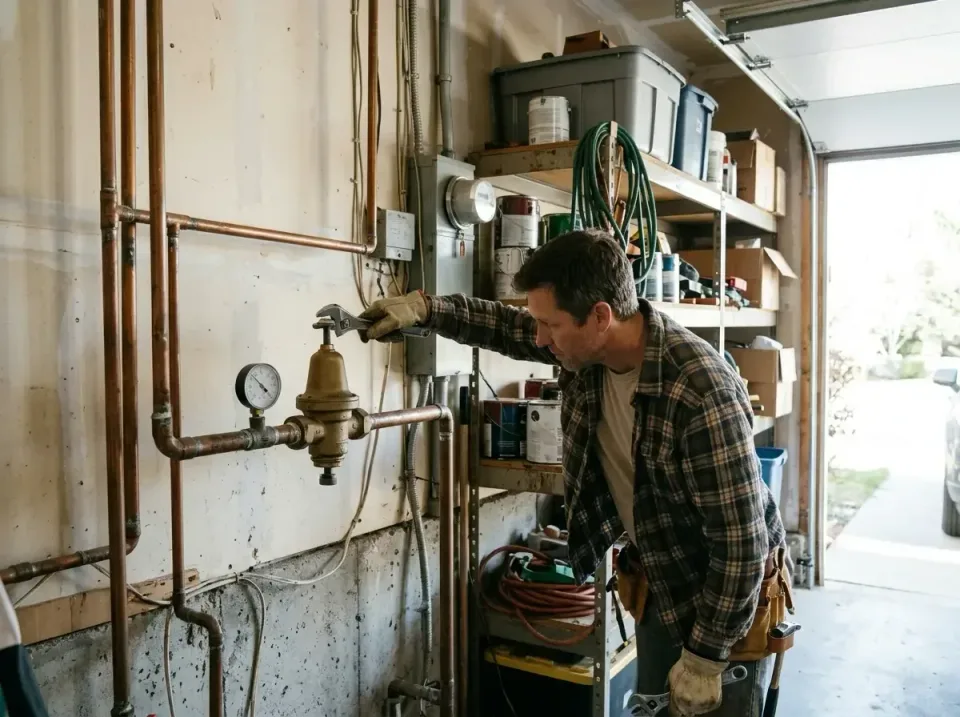
Can a Watts Valve Cause Low Pressure Throughout Your Home?
Yes, a Watts pressure-reducing valve can cause low pressure throughout a home if it is stuck, clogged, or adjusted too low. If the pressure suddenly falls at several faucets, the regulator is one possible cause, but a restricted service line or another plumbing problem can produce similar symptoms. Don’t adjust it blindly.
A summer thunderstorm can briefly interrupt power to a well pump, so note whether pressure loss follows an outage before blaming the valve. Coastal flooding can also affect low-lying properties; if water has reached plumbing equipment, avoid handling wet electrical components and arrange an inspection.
Near the Air Mobility Command Museum, as elsewhere in Delaware, tell the plumber whether the issue began after a storm. Ask for pressure measurements before approving a repair.
What Does a Watts Regulator Do to Home Pressure?
A pressure-reducing valve (PRV) lowers incoming water pressure to protect household pipes and fixtures. If its internal screen collects debris, its moving parts wear, or its setting is too low, the valve can restrict flow to multiple rooms. That can look like a whole-house failure. It is not proof by itself.
We start by checking whether several fixtures are affected and whether the pressure changes when water is running. A reading with every tap off shows static pressure; a second reading during flow helps reveal a restriction that a single measurement can miss.
This distinction matters when a customer reports pressure that seems acceptable at rest but collapses during a shower. In Delaware, a home near Battery Park in New Castle may have a different plumbing history from a newer property, so we inspect the actual piping rather than assume the regulator is at fault.
Could Another Problem Mimic a Failed Valve?
Yes. A partly closed main shutoff, a leak, a clogged filter, or mineral deposits inside older piping can also reduce pressure.
If only one faucet is weak, start with its aerator; a regulator is less likely to explain a problem limited to one fixture. If pressure falls across the house, we compare readings at an accessible hose connection and inspect the regulator and nearby shutoff.
Location can help shape the investigation, but it does not diagnose the plumbing. Inland areas generally experience fewer direct coastal effects, so a pressure complaint there may be less likely to follow coastal flooding; the supply, valve, and fixtures still need testing.
At a home near the Delaware State Capitol, we would ask whether the loss affects hot and cold water alike and whether it changes when multiple taps run. Those details help separate a regulator restriction from a fixture or supply issue.
When Should You Call a Plumber Instead of Adjusting It?
A homeowner can check whether the main shutoff is fully open and clean a removable faucet aerator. Stop there if the regulator needs disassembly, its adjustment is unclear, or several fixtures have lost pressure. Turning the adjustment screw without measuring first can leave the home with too little pressure or raise it beyond a safe level for the plumbing.
Our crew tests before recommending a repair. We compare pressure readings, inspect the valve and accessible connections, and explain what we find before work begins.
Delaware properties vary, and a regulator connection may need to match the existing pipe and installation. A home near the Newark Reservoir is no exception: the landmark does not determine a valve’s condition, but the symptom pattern and measurements do.
If the diagnosis points to the PRV, Pressure Regulator Repair describes the focused service.
What Should the Repair Address?
The right fix depends on the failure. A serviceable regulator with a minor issue may be repairable; a worn or obstructed valve may need replacement.
If pressure remains low after regulator work, the restriction may lie elsewhere, and replacing the valve alone will not solve it. We retest after the repair and check more than one fixture so the result reflects the home, not just a reading at the valve.
Humidity also matters during an inspection. High humidity encourages condensation in basements and crawlspaces, where moisture can make it harder to spot a small plumbing leak at a glance.
Near Delaware Park, as in other parts of the state, we look for visible dampness while tracing the pressure problem, rather than treating condensation as proof of a leak. Clear findings make the next decision easier.
Compare Pressure Tests and Repair Options
The right choice depends on whether low pressure comes from the regulator, supply, well equipment, or one fixture. Start with measurements.
Near Bombay Hook National Wildlife Refuge, a homeowner can mention whether damp conditions are present around plumbing, while remembering that local surroundings do not establish the cause. At Cape Henlopen State Park, salt air exposure is not a pressure diagnosis; inspect the actual fittings and valve condition.
| Option | Best for | Key detail |
|---|---|---|
| Water pressure testing | Unclear whole-house symptoms | Compare static and flowing readings |
| Regulator repair or replacement | A restricted or unstable PRV | Connections commonly 3/4–1 inch |
| Booster pump installation | Supply remains inadequate after diagnosis | Size by flow rate and lift |
| Well pressure repair | Pump or cycling-related symptoms | Check switch and tank operation |
High humidity can leave condensation in basements and crawlspaces, so distinguish surface moisture from an active leak before choosing a repair.
Prepare for a Watts Valve Pressure Check
-
Describe the symptoms: Note which rooms and fixtures are affected, and whether pressure drops when more than one tap runs. Cold winter nights can freeze exposed plumbing, so mention any recent freeze-related trouble.
-
Make the regulator accessible: Clear stored items near the water meter and valve, and protect flooring around the work area. Brandywine Creek State Park is a useful local reference when arranging service, but provide your actual address for scheduling.
-
Locate the shutoff: Find the main shutoff before the visit, but do not force a stuck valve. If you are near Delaware City, give the crew access details that help identify the property.
-
Plan for a brief interruption: Water may need to be shut off while the regulator is inspected or repaired; store drinking water if that interruption would affect your household.
-
Request before-and-after readings: Ask that pressure be checked with fixtures closed and while water runs, then confirm multiple fixtures after restoration. The Delaware Memorial Bridge is a regional landmark, not a travel-time promise; confirm appointment details directly.
Common Questions About Low Water Pressure Repair in Delaware
Can a Watts Pressure-Reducing Valve Cause Low Pressure Only Upstairs?
Yes, a Watts pressure-reducing valve can contribute to weak upstairs flow, especially if pressure falls throughout the system under demand. Freeze-thaw cycles can stress outdoor pipes and hose bibs, so note any exposed plumbing concerns, but have the regulator and supply tested before assuming one caused the other.
How Much Does It Cost to Fix a Watts Valve Causing Low Pressure Throughout the House?
Pressure regulator repair is $150–$500, while replacement is $300–$800, depending on valve condition, parts, size, and access. Pressure testing is $75–$250 based on diagnostic time and access; final quotes vary by scope, parts, access, and site conditions.
Should I Adjust a Watts Regulator Myself If Pressure Suddenly Drops Throughout the House?
No, do not turn the regulator adjustment without measuring pressure and confirming the cause. Winter precipitation can include rain, sleet, and occasional snow, so if the loss follows freezing conditions, mention exposed plumbing; Delaware Plumbing Pros can compare readings and explain repair options.
Do Delaware Rules Affect Replacing a Watts Pressure-Reducing Valve?
Yes, valve work must be considered under Delaware State Plumbing Code requirements and applicable Delaware plumbing contractor licensing requirements. The Delaware Division of Professional Regulation is a relevant source for licensing information, and the contractor should determine whether the specific job has additional requirements.
What Should I Check If a Watts Valve Is Not the Cause of Whole-House Low Pressure?
Check whether the main shutoff is open and note whether the pressure problem affects hot and cold water or changes when multiple taps run. If a home near the Grand Opera House in Wilmington has pressure symptoms after exposed piping trouble, account for freeze-thaw stress and have the supply and fixtures checked rather than replacing the regulator automatically.
Get a Clear Answer on Your Watts Valve
A faulty Watts regulator can restrict pressure across the home, but testing should confirm the cause before anyone replaces parts. Seasonal conditions can complicate symptoms: hot, humid summers increase cooling and ventilation needs, and plumbing equipment in poorly ventilated spaces may be harder to inspect comfortably.
Delaware’s humid subtropical climate also brings changing conditions that make a clear, measured diagnosis useful. Seasonal drought can affect private well supplies, so well owners should report any recent change in their source or pump behavior.
If several fixtures are weak or the pressure changes sharply, ask for a pressure check and an explanation of the findings. Contact Delaware Plumbing Pros at (877) 773-0781 or arrange Pressure Regulator Repair; we test first and explain options before work begins.
Services Offered
Services We Offer in Wilmington, DE
Explore related services available in Wilmington, DE.
We repair restricted hot-water flow at heaters and fixtures, checking connections and pipe condition; typical repairs may run $150–$500 depending on access and parts.
Emergency pressure loss repair tracks sudden supply failures and restores service for Delaware homes; Winterthur-area visits can involve access challenges, with cost driven by repair scope and parts.
Shower pressure repair covers weak spray and restricted shower flow; fixture access and parts affect typical $150–$500 repair costs. Near White Clay Creek State Park, Mispillion Riverwalk, and Rehoboth Beach Boardwalk...
Clearing accessible pipe obstructions and restoring flow for homeowners; typical jobs run about $150–$500, depending on clog depth and pipe access.
Whole House Pressure Repair checks home-wide flow and pressure controls; typical repair pricing depends on the affected parts and access.
Install a residential booster pump sized to the home; Delaware jobs typically run $800–$2,500, depending on pump capacity and electrical work. Storm access near Rehoboth Beach Boardwalk may delay visits.
We repair residential well pump pressure systems, checking pump controls and connections; diagnostic time and access shape typical $75–$250 testing costs.
We repair or replace well pressure tanks for homeowners, accounting for tank size and plumbing changes; scope determines the typical cost.
We trace concealed plumbing leaks for homeowners and property managers, checking accessible pipe runs and pressure loss; repair cost depends on leak location and access.
We repair residential pressure regulators, including accessible brass valve assemblies; typical repairs run $150–$500, depending on valve condition and parts.
We repair residential main water lines, including accessible copper or PEX sections; typical jobs run $600–$3,500, with excavation and pipe length affecting the total.
We repair residential softener valves, resin beds, and bypass connections; typical repairs run $150–$600, depending on parts and access.
Water Pressure Testing compares static and flowing readings at residential fixtures; typical testing runs $75–$250, with diagnostic time and access affecting the total.
We repair residential filter housings, valves, and clogged cartridges; access and replacement parts shape typical costs, often about $150–$600. Winter rain, sleet, or snow can complicate outdoor access.
Mineral Buildup Pipe Clearing removes scale from restricted household pipe sections; typical jobs run about $250–$1,500, depending on access and buildup.
Cities & Towns
Service Areas in Wilmington
Select a city to find local low water pressure repair providers we cover in Wilmington.
Wilmington, DE19802Dover, DE19901Newark, DE19717Middletown, DE19709Bear, DE19701Glasgow, DE19702Milford, DE19963Brookside, DE19713Hockessin, DE19707Smyrna, DE19977Pike Creek Valley, DE19808Claymont, DE19703Seaford, DE19973North Star, DE19711Georgetown, DE19947Wilmington Manor, DE19720Millsboro, DE19966Pike Creek, DE19808Edgemoor, DE19809Elsmere, DE19805New Castle, DE19720Laurel, DE19956Clayton, DE19938Camden, DE19934
Show all 41 cities
Rising Sun-Lebanon, DE19962Harrington, DE19952Highland Acres, DE19901Milton, DE19968Lewes, DE19958Selbyville, DE19975Dover Base Housing, DE19901Ocean View, DE19970Bridgeville, DE19933Townsend, DE19734Long Neck, DE19966Greenville, DE19807Delmar, DE19940Riverview, DE19946Millville, DE19967Kent Acres, DE19901Woodside East, DE19962
Get a Quote
Get a Low Water Pressure Repair Quote in Wilmington, DE
Share job details below or call our team directly. Phone: (877) 773-0781